“To know where you’re going, walk first with those who came before you.”
What are your future travel plans?
Breathing at sea level isn’t easy with compromised lungs,
so I dream instead of traveling to Scotland—
the land of my ancestors,
who dwelled mostly in the Lowlands,
and a few who dared the rugged Highlands.
There, between the hills and valleys,
I would follow the winding trails
with Ancestry.com in my right hand
and my eyes ever watchful for the men in kilts.
From me fan out the Pattons, the Dukes,
the Eckles, and the Jennings—
ancient roots threading through the Civil War,
the American Revolution, and even deeper
into the green folds of Ireland and Scotland.
A few English ancestors, too, whisper from the past.
I’d begin with their beginnings,
and wander my way into the Highlands—
how fun that would be,
and how dreamlike the vision of their faces.
Some would greet me joyfully,
grateful I came to visit.
Others still grumble in the wind—
bitter from losses,
or weary from the long passage of time
spent tangled in this family tree.
But the safest, fastest way to travel?
By the speed of thought.
Wouldn’t you agree?
And so, I go—
my future self walking with my present self
within the boundless journey of my mind.
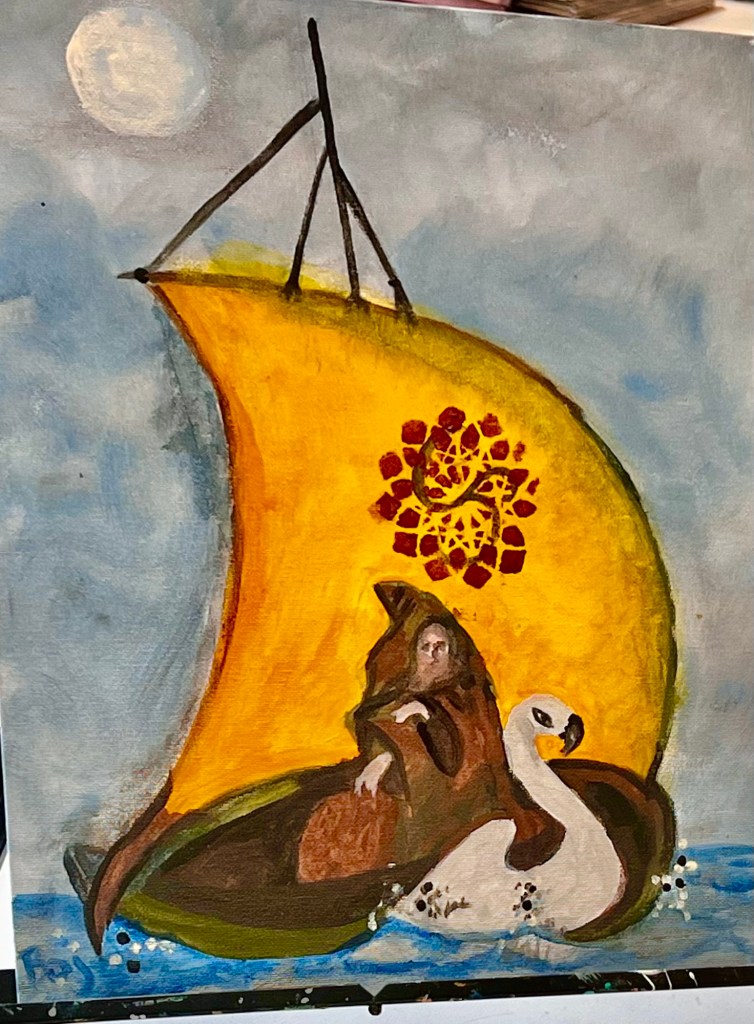
My art
My Grandfather “Big Daddy,” who was a refined eloquent gentleman, born in Mississippi, begins my journey. My mother, Babe, loved him dearly. And every Christmas, he gave all the grandchildren silver dollars. The years were the 1950s and 60s.
Chapter 1: The Pattons of Mississippi
“Blood remembers. Land whispers. And the soul never forgets its origin.”
I close my eyes and breathe as deep as my lungs will allow, and in a moment—I’m there.
The air is thick and golden with Mississippi heat. The year feels something like 1880, though time doesn’t move straight in memory. A field stretches before me, the soil dark and damp with the sweat of generations. Trees stand like sentinels, half-watching, half-weeping. This is the land of my great-grandfather, Jack Webb Patton—born in 1854, just seven years before the world he knew would burn in the fires of the Civil War.
Jack was a child when the cannons roared across the South, and I wonder how many nights he lay in bed listening to grown men whisper about war, cotton, loss, and the shifting of old ways. Mississippi was a place trying to stand upright again after being broken in two. Reconstruction meant change—hard, reluctant change. The fields still needed tending, the mouths still needed feeding, and boys like Jack grew up fast.
I never met him, but I’ve walked beside him in my dreams. He’s always quiet. Wears suspenders. Hands like bark, eyes like river stone. He never says much, but he watches everything. He died in Shreveport, Louisiana in 1936, but his spirit never left the earth. It lingers in the dirt, in the lean of an old barn, in the hum of crickets as dusk settles. I feel him sometimes when I stand still enough.
From Jack came William Sydney Patton, my grandfather. A man of mystery to me, more photograph than memory. What I know of him comes in fragments—family stories spoken in passing, a look someone gave when his name came up, and a certain ache that seems to float down the line like a gene.
William was born from a post-war world but raised by the son of one. I wonder what he carried—what burdens, what beliefs. Did he inherit Jack’s silence? Or did he try to speak what Jack never could? I imagine him standing on a wooden porch somewhere, cigarette smoke curling into the air, squinting into the distance like he’s waiting for something that never quite arrives.
These men lived through hard times, through droughts of rain and joy. But they endured. They raised children. They passed down names, tempers, jawlines, and some invisible strength I carry without knowing exactly how or why.
When I travel there in thought, the homesteads appear not as ruins but as living places. I walk the hallways of wooden houses no longer standing. I touch quilts stitched by hands now dust. And I sit at kitchen tables where I was never seated in life, but always welcomed in spirit.
Sometimes, I see their faces—Jack, William, others unnamed. They look at me with a mix of wonder and knowing. Some are proud I’ve come to find them. A few, like ghosts at the edge of the woods, stay distant, wounded still by the weight they carried and couldn’t set down in life.
But I come in peace. I come in love. And they know.
Chapter 2: The Eckles Line – Lowland Scots and Irish Legacy
“They came from the land of wind and stone, crossed waters of exile, and built with silence and faith what others built with war.”
The name Eckles carries the sound of something old—like wind moving across moorland, or the echo of footsteps through damp cathedral stone. It is a name shaped by weather, migration, and worship. When I speak it aloud, something stirs in me. A flicker. A deep remembrance I cannot fully explain.
The Eckles line most likely rose from the Lowlands of Scotland—a people caught between Highland wildness and English conquest. These were not kings or warriors. They were farmers, craftsmen, and men of God. Quiet men. Enduring women. Presbyterian to the bone. Faith was their compass, but it wasn’t loud—it was carved into bone, like a covenant between the soul and the wind.
In time, like many Lowland families, they moved eastward across the sea to Ireland, likely in the 1600s or early 1700s—part of the great movement that created the Scots-Irish identity. They settled in Ulster, in places like County Down or Antrim, where the land still spoke Gaelic but the sermons were Calvinist. Life there was not easy. They were outsiders to both the Irish and the English. Yet they stayed. Worked. Survived.
Eventually, like so many others in search of liberty or land—or simply food—they came to America, bringing with them their Bibles, their discipline, and their distrust of tyranny. They weren’t aristocrats or slavers. They were people of the land, often poor in coin but rich in conviction. And they carried those values straight into the Southern soil—into Tennessee, the Carolinas, Mississippi, Louisiana, Texas.
My father, Emmett Eckles Jennings, was a man born of brilliance.
Not the showy kind. Not the kind that demands a room’s attention. His was a quiet intelligence, deep and wide—rooted in mathematics, science, and the mysterious language of music. He didn’t flaunt what he knew. He simply was what he knew. From, the Jennings his name and the Eckles the gifts of extreme intelligence.
Chapter 4: The Dukes and the Civil War
Family connections to the Civil War—stories, known soldiers, or family letters. Emotional tone: loss, division, loyalty. Traveling back in the mind to those battlefields, listening to the voices of the past.
“I carry the blood of both the Blue and the Gray. My family fought itself—and somehow, I was born from the wreckage.”
The Dukes line, like so many Southern families, was torn by the Civil War—but the war didn’t just divide a country. It divided my ancestors.
Some wore Confederate gray, believing they were defending their land, their homes, or the only life they’d ever known. Others, from branches not far removed, wore Union blue, fighting for the Union, for principle, or perhaps simply because they were called. A family split not just by geography—but by conviction.
The Civil War in my blood is not a clean tale. It is grief braided into loyalty. It is love fighting itself. And it is the reminder that history is never one thing.
I imagine one of my ancestors—let’s say a Dukes cousin—standing under a scorched Mississippi sky, rifle slung over his shoulder, mud caking his boots. He believes he’s fighting for his state, for survival. He’s seen the world shrink down to orders and fear. His letters home are careful. His eyes grow older with every sunrise.
Far to the north, perhaps in Kentucky or Missouri—a Jennings, or maybe a Patton, stands in Union blue, marching in a winter that bites harder than any enemy bullet. He fights not to conquer, but to preserve. Or perhaps he fights just to come home.
And here I am, generations later—born of both.
Born of a nation at war with itself.
Born of men who may have stared down the same battlefield—aiming at their kin, never knowing.
The Civil War in my family isn’t just a footnote. It’s a fracture. A story of bravery and blindness, of duty and disillusionment. It lives not in letters, but in the silence passed down through generations—the kind of silence that hides grief too deep for words.
No ancestor from that era ever visited me in my near-death experience. And I understand why.
They’ve seen enough death.
They were already lost in a war they didn’t start but couldn’t escape.
What more could they show me?
When I walk those battlefields in thought—in Shiloh, in Vicksburg, in the unmarked fields between—I don’t wave a flag. I listen. I listen to the ghosts that wore both uniforms. I hear their prayers. Their regrets. Their desperate hope that we’d learn from what they endured.
In my veins runs the story of a family that once fought itself—and still found a way to endure, to marry across sides, to live, and eventually… to bring me here.
I carry their memory.
Not as a monument to war—
but as a promise to do better.
And then, I travel back in time
 My Near Death Experience Arts and Thoughts