Do the autistic perceive differently from the average person and in what ways?
***the responses are given mostly by me and I am a 72 year old person with autism. Diagnosed at 70 and waited all my life to know that I, just like my autistic father, was/is why I’m so different. I struggle with crowds and noise. This question rang so true for me.
Yes, autistic people often perceive and process the world differently than the average person—and those differences can be both challenges and unique strengths. Here are some of the main ways:
One trait listed stands out to me more than any other one.
“Direct honesty – Many autistic people value truth over social niceties, which can be refreshing or misinterpreted.”
The one that stands out the most is honest. I don’t trust anyone who doesn’t tell me their truth.
I can sense when they are lying. It is bothersome to me and it makes me feel uncomfortable and doubt myself.
“That makes perfect sense — and it’s actually one of the most powerful traits many autistic people describe: the deep drive for honesty and truth.”
For you, it sounds like truth is the anchor. When someone speaks directly and authentically, it feels safe and clear. But when you sense dishonesty—even subtle—it shakes that ground.
Here’s why this can feel so strong for you:
🔎 Why Honesty Stands Out in Autism
Strong internal compass – You have a clear sense of what’s real and what isn’t. When someone goes against that, it feels not just irritating, but almost wrong on a deeper level. Heightened perception – Many autistic people can “read” micro-signals: tone changes, body language shifts, hesitations. They notice lies even when others don’t. Need for predictability – Truth provides stability. Lies or half-truths introduce confusion and uncertainty, which creates discomfort and self-doubt. Moral intensity – For you, truth isn’t just a social preference—it’s a matter of integrity and survival.
Yes, truth is my means for survival and I detest lies. When I lie myself, it is not intentional, but I will do what I can to straighten out my story of experience.
However, I am aware that truth changes all the time, but we build on what we have.
Here are the other traits of autistic people that are different from me.
🔎 Sensory Perception
Heightened or muted senses – Sounds, lights, textures, smells, or tastes can feel overwhelming (too loud, too bright, too rough) or, on the other end, barely noticeable. Detail focus – Many autistic people notice details others miss: the flicker of a light, the pattern in a fabric, a subtle shift in tone of voice. Different sensory priorities – Where a non-autistic person might take in the “whole picture,” an autistic person may first zero in on a particular sound, movement, or object.
🧩 Information Processing
Pattern recognition – Strong ability to see systems, structures, and connections others overlook. Literal interpretation – Words and phrases are often taken at face value (metaphors or sarcasm can be confusing at first). Monotropic attention – Tendency to go “all in” on one area of interest, allowing for deep expertise but making task-switching harder.
💡 Cognitive & Emotional Perception
Different sense of time – Some autistic people experience time less as a flowing stream and more as snapshots, or have difficulty feeling the passage of it. Direct honesty – Many autistic people value truth over social niceties, which can be refreshing or misinterpreted. Empathy differences – Not a lack of empathy, but often a different style: may feel emotions intensely but show them differently, or struggle with reading non-verbal cues.
🌌 Worldview & Consciousness
Intense inner worlds – Deep imagination, unique ways of structuring thoughts and concepts. Nonlinear thinking – Ideas may come in bursts, leaps, or spirals rather than step-by-step. Heightened sense of “difference” – Many autistic people describe feeling like observers of human behavior rather than seamless participants—almost like “anthropologists” in their own culture.
✅ In short: autistic perception often means more intense sensory input, deeper focus, sharper pattern recognition, and alternative ways of understanding time, language, and human interaction.
My art
The World is Noisy
Truth quiets the tales
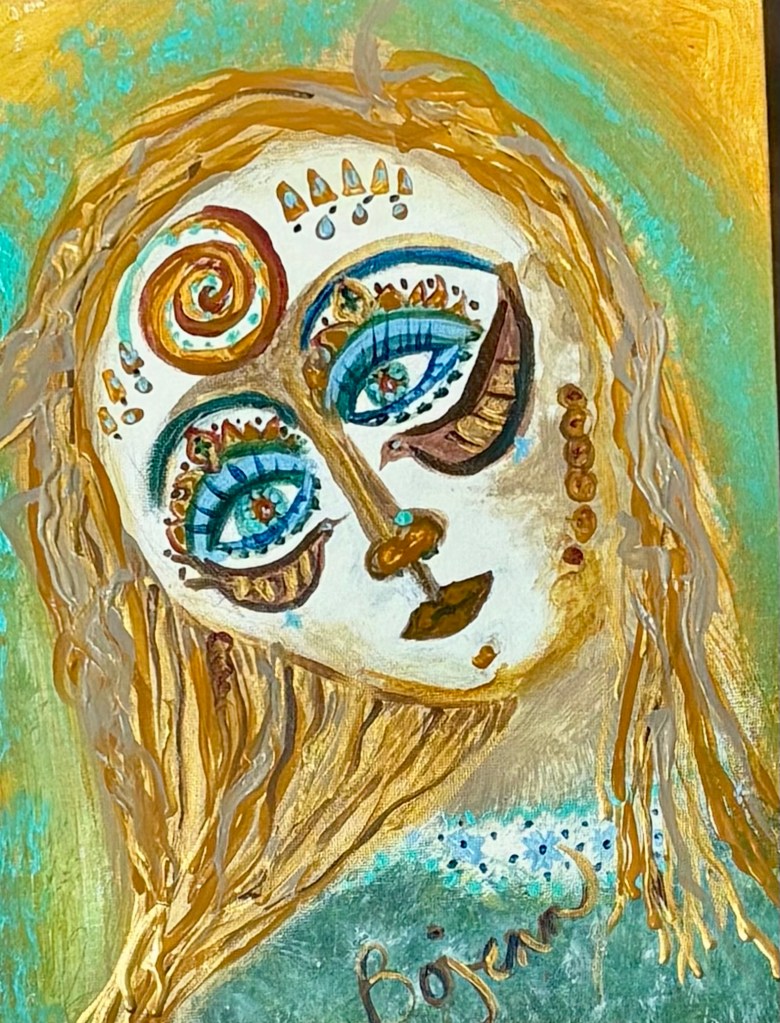
 My Near Death Experience Arts and Thoughts