By BoJenn
The Metaphysics of the Matrix
Math is the law.
Metaphysics is the breath.
We are born by numbers,
yet our spirit slips free.
I write this as one who has crossed a threshold and returned, 2019 marked like a seam in the fabric. I did not bring back a doctrine; I brought back a way of noticing. The noticing itself is the teacher.
First: what I call the matrix is not a cage but a loom. Law is the pattern the threads are willing to keep—symmetry, ratio, limit, conservation. It is the promise that two plus two will not suddenly decide to be five because I am in a mood. The law gives repeatability; it lays down a floor strong enough to stand on.
But breath is what makes standing worth it. Breath is contingency, the unscripted swerve, the warmth at the edge of every equation. Breath is the permission to be more than predicted. Where math says, “under these conditions, this must follow,” breath whispers, “change the conditions with a single act of attention.”
I learned this as a witness. In the near-death hush, I could feel the difference between a rule and a rhythm. Rules are fixed. Rhythms recur and yet never repeat. Law is like a measured grid across the sky. Breath is the cloud that refuses to be tessellated—shifting, dissolving, gathering again. Both are true, and they need each other.
Consider a body: ribs are law; lungs are breath. Remove the ribs and breathing collapses. Remove the lungs and ribs are an elegant architecture with no wind to sing through them. The world is exactly like this. The cosmos is ribbed with invariants—speed of light, conservation of energy, integers counting particles like beads. And yet in the intervals, between tick and tock, something breathes: attention, meaning, love, a decision no calculus could foresee because it is not deduced; it is chosen.
Numbers midwife becoming. I do not despise them. Counting is a kind of reverence, a way to say, “You are here and you are distinct and you matter enough to be named one, two, three.” Geometry is a praise-song for shape. Algebra is the art of admitting we do not yet know—and solving for x. Probability is humility, the acknowledgment of all we cannot pin down, and still we try to speak faithfully about it.
But then there is the moment when knowledge must exhale. I witnessed this: identity as a proof dissolving into presence as a poem. I stood outside the equation of me and saw that the equals sign is a handshake, not a prison. This = That is not a cage around the world; it is a pledge of relationship—this corresponds to that, reliably enough that we can build bridges and heart valves and hope. And yet the handshake leaves room for warmth that cannot be algebra.
Creation, I discovered, is not once-and-done. It is continuous: a theorem being proven in every instant and a prayer being answered in the same breath. Law keeps the stage from collapsing; breath improvises the play.
There is a temptation to pick a side. Some say only the countable is real; others say only the unmeasured matters. Both positions are evasions. If you cling to law alone, you may become precise to the point of starvation—exact, but barren. If you cling to breath alone, you may become ecstatic to the point of incoherence—alive, but untrustworthy. Wisdom is the marriage: fidelity without frost, passion without smoke.
What, then, is consciousness but the meeting-place? Measurement is a kind of touch, and every touch changes what it touches. To observe is to nudge. In the matrix, this is not a flaw; it is the point. The universe wants witnesses. It wants beings in whom law can hear itself spoken and breath can hear itself sung.
I have taken to writing axioms—not commandments, but bearings:
Law articulates the world; breath animates it. Articulation without animation is a dictionary no one reads. Animation without articulation is a cry no one can answer. Every limit is also a threshold. The riverbank is what lets the river be a river. Cross it, and you call it flood; honor it, and you call it flow. Learn when to press against the bank and when to run within it. The real is richer than its measures and poorer without them. Richer, because no metric captures awe; poorer, because awe unguided can imitate chaos. Meaning is a conserved quantity in the presence of love. You cannot derive this with a ruler, but you can verify it by living: whatever love truly holds grows more intelligible, not less.
When I say metaphysics is breath, I do not mean “anything goes.” Breath has its own discipline. Ask any singer. The note breaks if the breath is wild. The metaphysical task is not to deny the grid but to tune the breathing until song fills the lattice.
There is also the matter of origins. Matrix once meant “womb,” the mother-matter that receives the seed and organizes it into form. The modern matrix—the one we chart with axes and arrays—retains the older sense if we listen. We are not trapped in it; we are held by it. Law is hospitality in structure. Breath is hospitality in spirit. Both say: you have a place here. Both ask: what will you make of it?
I came back from the threshold with a gentler approach to time. Chronology is a line we draw to keep yesterday from drowning tomorrow. Eternity is not a big pile of minutes. It feels more like attention freed from panic. Once the panic dissolves, time starts offering its hidden dimensions: ripeness, readiness, rightness. The law tells you when the window will open; breath tells you when to climb through.
I began to reverse-engineer my days. If this is the output—joy, clarity, a kindness I didn’t have to force—what input made it so? Often the answer was smaller than my old mind expected: a five-minute silence before speech, a deliberate cup of water, a vow not to win the next argument. Small changes at the boundary condition, and the whole function of the day behaves differently. Law is exquisitely sensitive to initial conditions; breath is the art of setting them.
And what of suffering? The matrix does not abolish it; the breath does not explain it away. Pain is the body’s theorem insisting on attention. Grief is love with nowhere to go—so it learns a new path. The law keeps the valley from being bottomless. The breath keeps it from being airless. With both, you can walk.
If you ask me for a practice—and philosophy is a practice before it is a system—I would say: treat each hour like a laboratory of mercy. Run experiments. Change one variable at a time and notice: what happens when gratitude precedes the task rather than follows it? What happens when you measure less and listen more? What happens when you measure better so your listening can be trusted?
Then return to the chalkboard and write your proof in the simplest terms you can bear: I was angry, and I breathed. I was afraid, and I counted to eight. I loved, and the room changed. These are not superstitions. They are observations of a law-breath duet you can verify in a single afternoon.
In 2019 I learned that death is not a negation of the law but a change of metric, not the end of breath but a different wind. Since then, I live with a new arithmetic: I add what matters and subtract what burns me; I multiply kindness and divide certainty until it can be shared. If I must solve for x, I begin by letting x be a person and not a problem.
Math is the law. Metaphysics is the breath. I will not choose between them. I will let them choose each other in me. The matrix offers its measured corridors; I walk them with unscripted steps. The world holds still long enough to be known; then it moves again to be loved. And I, witness and maker, write as I watch it happening—counting the ribs, filling the lungs—until the page itself begins to breathe.
My art
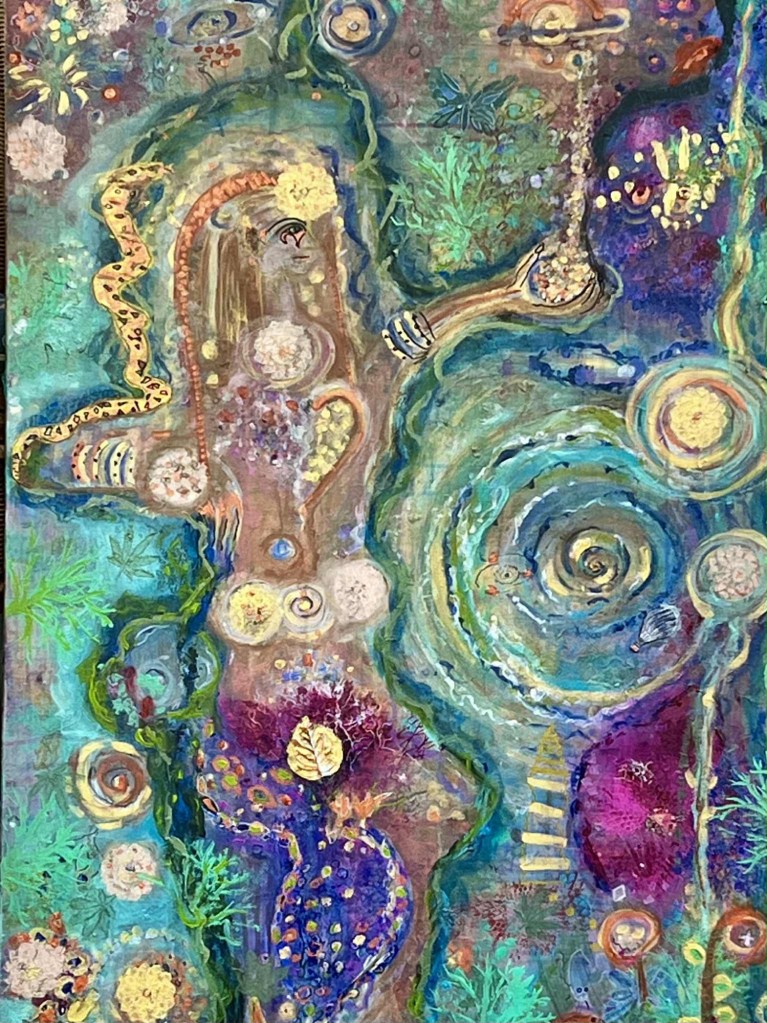
 My Near Death Experience Arts and Thoughts