
It’s time to learn (9th grade level)
By BoJenn and AI
Silent sparks of light,
cells whisper in quantum code,
mind blooms in the glow.
Have you ever thought about consciousness and the energy in it, behind it, through it and manifesting it?
Yes, I have too, so let’s explore our consciousness together. Written here are two examples of energies given to help explain the theory of how and why consciousness works.
We will use the new familiar terms such as quantum mechanics, design, and information. All are hypothetical, but soon to be verified.
The meaning of these findings is pretty big when looked at through QIH (Quantum Information Hypothesis).
Normally, we think of biophotons — tiny flashes of light given off by cells — as just random sparks. But what if they’re not random? What if they act more like signals, carrying quantum information?
In QIH, light can carry “frequency codes” that shape how matter is organized. In living things, this might mean biophotons help organize cells, body structure, and even conscious thought.
Take microtubules as an example. They’re like the “highways” inside cells, moving materials around and keeping the cell’s shape. But because they’re tube-shaped and can shift their structure, scientists think they might also work like antennas, holding and transmitting quantum signals.
Here’s where the Orch-OR model comes in. It suggests that microtubules can hold tiny “quantum states” — kind of like computer bits, but at a quantum level. When those states collapse, it creates little bursts of conscious awareness. Imagine flipping a light switch on and off really fast — each flip is like a “moment” of awareness.
Biophotons, in this view, might be both the sparks that trigger these switches and the light that comes out afterward. For example:
Initiators: Like a starter pistol at a race — biophotons might kick off a quantum state in the microtubules. Products: Like sparks from a fire — they might also be released as a result of these quantum changes.
So in simple terms: cells might use tiny flashes of light (biophotons) and cell “tubes” (microtubules) to create the building blocks of thought and awareness.
***
The Orch-OR model stands for “Orchestrated Objective Reduction.”
It was proposed by Roger Penrose (a physicist) and Stuart Hameroff (an anesthesiologist) as a theory of consciousness. Here’s the idea broken down:
Quantum states in the brain: Inside neurons, microtubules (tiny tube-like structures) may hold quantum states, similar to how a computer holds bits of information — but at the quantum level. Objective Reduction (OR): These quantum states don’t last forever. They collapse, or “reduce,” when they hit a certain threshold — Penrose suggested this threshold is tied to gravity at the quantum scale. Orchestrated (Orch): Hameroff suggested that the brain orchestrates these collapses using biological processes, like neural signaling and biochemistry.
When these collapses happen in a coordinated way, the theory says they create moments of conscious awareness. Instead of consciousness being just the firing of neurons, Orch-OR suggests it’s tied to quantum events happening in microtubules, influenced by things like biophotons.
👉 Simple example: Imagine your brain as a massive orchestra. Each microtubule is like an instrument playing a note. The “objective reduction” is when the notes come together into a final chord. That chord = a moment of awareness. The “orchestration” part is how the brain keeps the instruments in sync so it’s not random noise but a conscious experience.
My Art
We Learn Daily
Hopefully
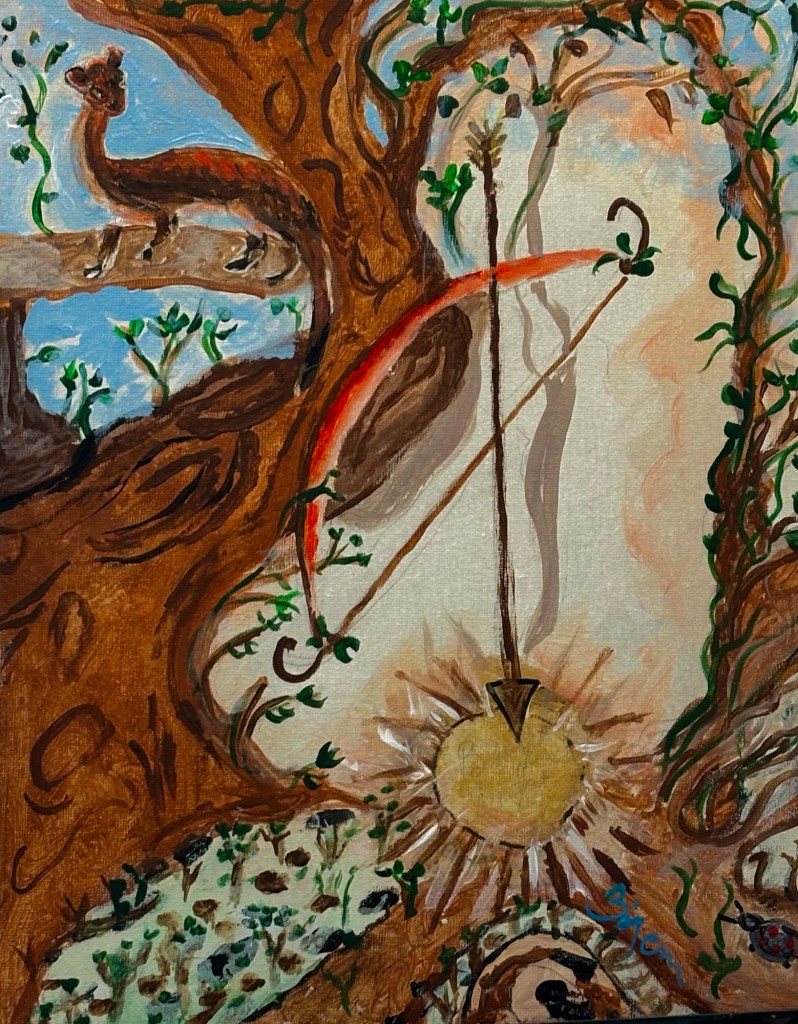
 My Near Death Experience Arts and Thoughts