
What will your life be like in three years?
This object could determine all of our lives. Let’s see what AI says.
🌌 Age of 3I/ATLAS
Estimated Age: Between 5 and 10 billion years old. That means it likely predates our Sun, which is about 4.6 billion years old. In other words, this object formed in another star system, perhaps one older than ours, and has been drifting through interstellar space ever since. Composition: Based on its brightness and trajectory, scientists think it’s likely a comet-like body — a mix of ices and rock, darkened by cosmic radiation from countless millennia in deep space. Its surface has likely been irradiated and altered by cosmic rays over billions of years, turning it darker and chemically complex.
🚀 Journey and Discovery
Discovered: Early 2025 by the ATLAS (Asteroid Terrestrial-impact Last Alert System) telescopes in Hawaii. Designation: The “3I” means third interstellar object (after 1I/ʻOumuamua in 2017 and 2I/Borisov in 2019). Path: It’s moving on a hyperbolic trajectory, meaning it’s not bound to the Sun and will continue outward — it’s just passing through. Speed: Roughly 25–30 km per second, faster than typical comets from our solar system.
🔮 Why its age matters
Because 3I/ATLAS comes from another star system, studying it gives astronomers a time capsule from before our Sun even existed — matter formed around another star, possibly even before the Milky Way’s spiral arms took their current shape.
In that sense, it’s ancient beyond Earthly time, carrying in its atoms the record of cosmic evolution — star birth, death, and rebirth.
AI Overview latest news:
👽 Why some people wonder
It’s only the third interstellar visitor ever seen (after 1I/‘Oumuamua and 2I/Borisov). ‘Oumuamua showed strange features — it tumbled oddly and didn’t have a visible tail — which led a few scientists (like Avi Loeb) to propose an artificial origin hypothesis. Because 3I/ATLAS also comes from interstellar space, some enthusiasts link it to that same line of thought — that these might be messengers or remnants of civilizations beyond our system.
But the data for 3I/ATLAS don’t support that idea so far.
🪐 If we think symbolically or speculatively
If one wanted to explore the mythic or metaphysical angle — as people once did with comets and stars — 3I/ATLAS could be seen as a cosmic messenger, carrying material from worlds we may never see. In that poetic sense, it connects civilizations: not by design, but by destiny — dust from another sun drifting into ours.
But that’s metaphor, not evidence.
How it could affect our lives in the next 3 years?
Positive / Good
Scientific knowledge: Because 3I/ATLAS is from outside our solar system, studying it can offer new insights into the formation of other star systems, interstellar material, maybe even pre-solar system chemistry. That could trickle into better understanding of our place in the universe. Technology and instrumentation: Studying such objects often drives improvements in telescope technology, sensor systems, data-analysis techniques. Those improvements can spill over into other applications (earth-observing, materials science, etc.). Public interest / education: These kinds of discoveries often spark public engagement with science, which is good for culture, education, STEM interest.
Neutral / Limited direct impact
For most people’s daily lives (jobs, finances, local concerns) the effect is likely very small. There’s no immediate hazard, no big disruption expected. It’s not likely to lead to immediate commercial applications (at least within 3 years) in any major way; most benefits are longer-term scientific/technological “spin-ons”. Because the object is passing through and will leave, the window of direct study is limited — so while interesting, it might fade from everyday attention.
Now the bad
Risks / Concerns
Very minimal direct risk to human life or infrastructure, given current understanding (no collision threat). One possible risk: if hype builds up (especially in popular culture) it could lead to misunderstanding or fear (unfounded). But that’s more social than physical. Scientific risk: If misinterpreted data or sensational claims (e.g., that it’s alien technology) become prominent, that could lead to confusion or resource diversion.
AI believes this
My overall judgment: is it good, bad, or neither?
Given the evidence and likely impact, I’d assess that the arrival of 3I/ATLAS is mostly good (from a scientific and knowledge standpoint), and mostly neutral in terms of its direct impact on everyday human life over the next 3 years. It doesn’t appear to be bad (no threat), but its benefits are more “long-tail” than immediate.
So, here my ideas of the future lie… do you understand how old this comet is?
Estimated Age: Between 5 and 10 billion years old
Wow!
My Art
It takes an abstract mind to interpret the possibilities
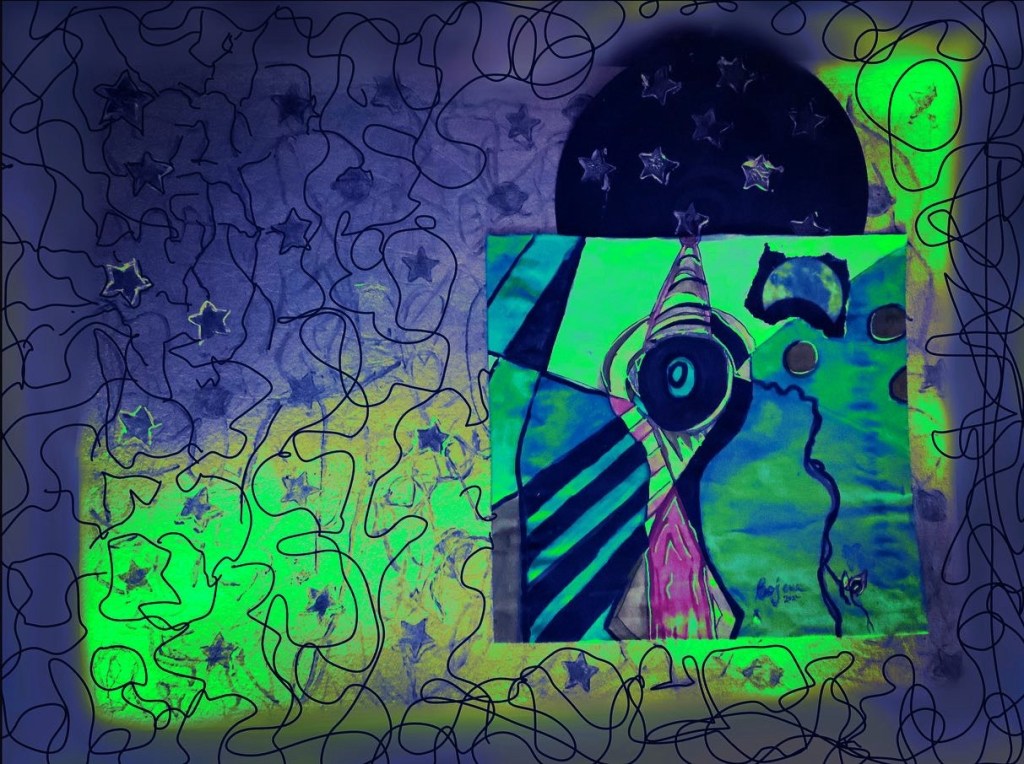
 My Near Death Experience Arts and Thoughts
4 responses to “A1 Atlas”
Excellent article on AI Atlas, BoJenn! Thanks for sharing this information with us. Happy Blogging ✍️💫✍️!
LikeLiked by 1 person
Thx Tracy, I enjoy hearing about this and the elements of anticipation… what is it?
LikeLiked by 1 person
Exactly! It’s a fascinating time! We are so lucky to witness this cosmic encounter! I’m so tempted to get a telescope!
LikeLiked by 1 person
You should get a telescope! And a nice one!
LikeLiked by 1 person