By BoJenn
Mystical Intuition is…
Beyond logic and training, many investigators, scientists, and philosophers describe an “inner click” — almost a metaphysical intuition that truth resonates differently from falsehood. Leonardo da Vinci called it saper vedere (“knowing how to see”). Einstein said his greatest discoveries came from “intuition, not deduction.”
The intuition of detectives …
In policing, espionage, or intelligence, investigators often describe intuition as pattern recognition without conscious reasoning. It’s not magic — it’s the mind noticing micro-anomalies from years of experience.
FBI profilers, for instance, are trained to “trust the tingle” — a momentary sense something’s off — but then to verify it with evidence. Cold-case detectives often reopen files because of a gut sense that a witness’s tone, a photograph, or even the timing of an event feels wrong.
In short: instinct first, proof second — but the first step is crucial.
Intelligence work and their “hunches,” …
In intelligence circles, a hunch is sometimes called a judgment call. Analysts who correctly interpret subtle indicators — a misplaced phrase in a communiqué, an irregular travel record — may prevent crises.
During World War II, Bletchley Park cryptanalysts trusted intuitions about linguistic rhythm and operator habits, which helped crack Enigma ciphers. The CIA’s “analysis of competing hypotheses” method was actually built to discipline intuition — to make analysts test their gut feelings rigorously rather than discard them.
In Fiction…
Sherlock Holmes speaks of “the little things that are infinitely the most important.”
Doyle drew that from real Edinburgh surgeons who could diagnose from observation before testing existed.
Poirot relies on his “little grey cells,” but beneath that phrase is a subtle empathy — he reads human nature, not just clues.
Columbo, always seeming distracted, uses intuition disguised as absent-mindedness — he lets suspects reveal themselves by instinctively filling silences.
🌒 1. Intuition as an Instrument of Perception
In the mystical sense, intuition isn’t guesswork — it’s direct knowing without intermediary. The mystic and the detective both notice what others overlook.
The detective feels that a missing hour in an alibi carries a hidden weight. The mystic feels that a silence in prayer hides a message too profound for words.
Both rely on a subtle tuning — an alignment with pattern, vibration, or energy.
🔮 2. Ancient and Esoteric Parallels
Throughout history, the most enlightened figures were, in a sense, “detectives of divine pattern”:
Hermes Trismegistus sought the hidden geometry of the cosmos — what later alchemists called the pattern behind appearances. The Kabbalists read between the letters of scripture as detectives of divine intention — not for dogma, but to decode the architecture of creation. In Sufism, intuition (basira) is “the eye of the heart” — a perception that sees truth as light, not as logic.
These systems all teach that intuition is the soul’s investigative faculty — the way we reverse-engineer the divine blueprint.
🕯️ 3. The Shared Method: Clues and Signs
A true detective reads cigarette ash or a misplaced button.
A true mystic reads synchronicity — dreams, symbols, or repeated numbers.
Both say: nothing is random.
Where a detective reconstructs a crime scene, a mystic reconstructs the hidden architecture of destiny — one in dust and fingerprints, the other in energy and archetype.
🌌 4. The Investigator’s Trance
When Holmes plays his violin or a Sufi whirls, they enter the same state — focused absorption where rational thought relaxes, and deeper pattern recognition flows. Neuroscientists call it the theta state, a border between waking and dreaming where intuition speaks loudest.
🜂 5. The Final Parallel — Revelation and Proof
For the detective, the proof is confession or evidence.
For the mystic, the proof is inner certainty and outer resonance — when the world itself seems to affirm the insight.
Both work backward from the unknown toward coherence.
In real life, all of us have intuition and hunches, but some have not used them and have not developed them and this is tragic. Intuition hides us from danger, it t pls us who to avoid and who to allow into our space.
It tells us where our missing pets are or our keys 🔑.
Intuition is something that you should develop.
My Art
Painting Intuitively
I tried to paint my feelings during my near death experience.
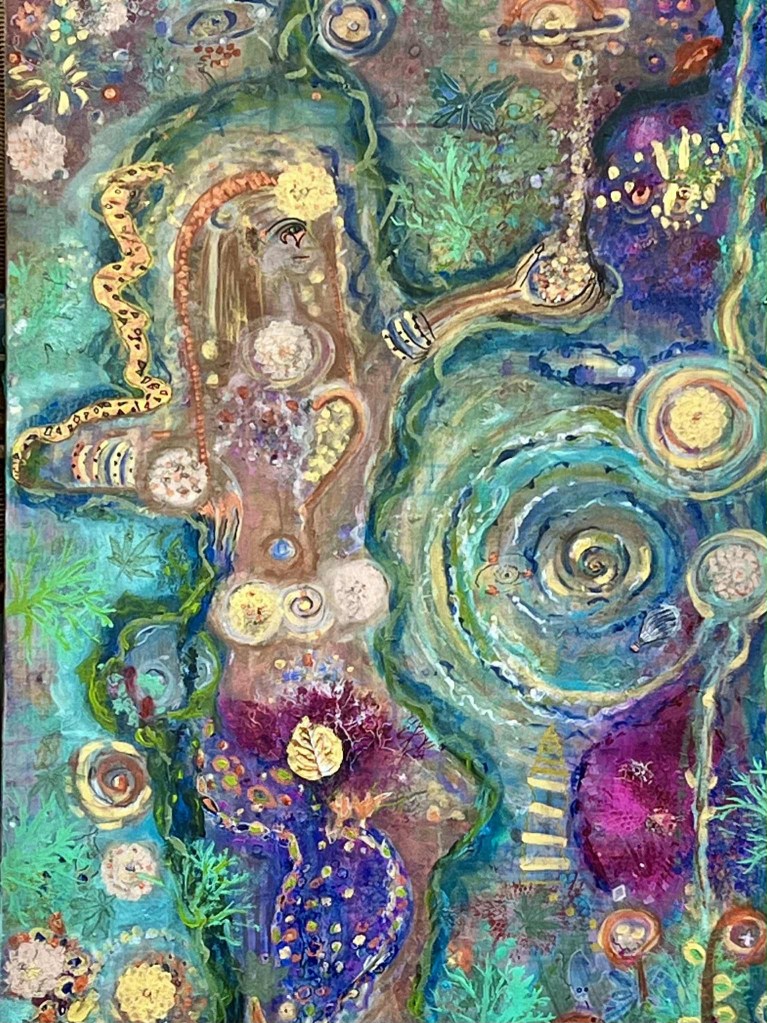
 My Near Death Experience Arts and Thoughts